🌳 FOREST CONSERVATION METHODOLOGY
Students Army is committed to restoring and protecting Kenya's
forests while addressing the environmental pressures that cause
deforestation, land degradation, biodiversity loss, and the
destruction of natural ecosystems.
🚨 FIGHTING DEFORESTATION
Deforestation threatens forests, rivers, wildlife, biodiversity,
soil, and community livelihoods. Students Army promotes practical
conservation approaches including:
- Sustainable land-use practices.
- Responsible management of river resources.
- Community-led forest protection.
- Youth-driven conservation advocacy.
- Protection and restoration of degraded ecosystems.
🌱 AFFORESTATION ACTION
We support tree-planting initiatives in schools, communities,
public spaces, farms, and degraded landscapes to:
- Restore lost forest cover.
- Improve local environmental quality.
- Protect biodiversity and natural habitats.
- Reduce soil erosion and land degradation.
- Strengthen climate resilience.
🌱 Every tree planted is a step toward a greener Kenya.
🌍 OUR COMMITMENT
Through practical action, environmental education, innovation,
and partnerships, Students Army is building a generation that
understands the value of forests and takes responsibility for
protecting them for future generations.
FAST-GROWING & RESTORATION-SUITABLE TREES
🌲 1. GREVILLEA ROBUSTA
Silky Oak
A widely planted tree in Kenya, particularly in
agroforestry systems and farms. It can provide timber,
shade, and useful farm-system benefits when appropriately
managed.
- Fast-growing under suitable conditions.
- Can reach substantial height.
- Suitable for agroforestry.
- Useful for farm and mixed-cropping systems.
- Valuable timber species.
- Can provide shade for selected crops.
- Suitable regions include parts of Central, Rift Valley, and Western Kenya.
🌳 2. EUCALYPTUS
Blue Gum
Eucalyptus species are widely grown commercially because
of their rapid growth and demand for poles, timber, and
other wood products.
- Rapid growth under suitable conditions.
- Commercially valuable.
- High demand for poles and timber.
- Suitable for managed woodlots.
- Can provide strong economic returns.
- Plant according to local ecological guidance.
- Avoid inappropriate planting in wetlands and sensitive water ecosystems.
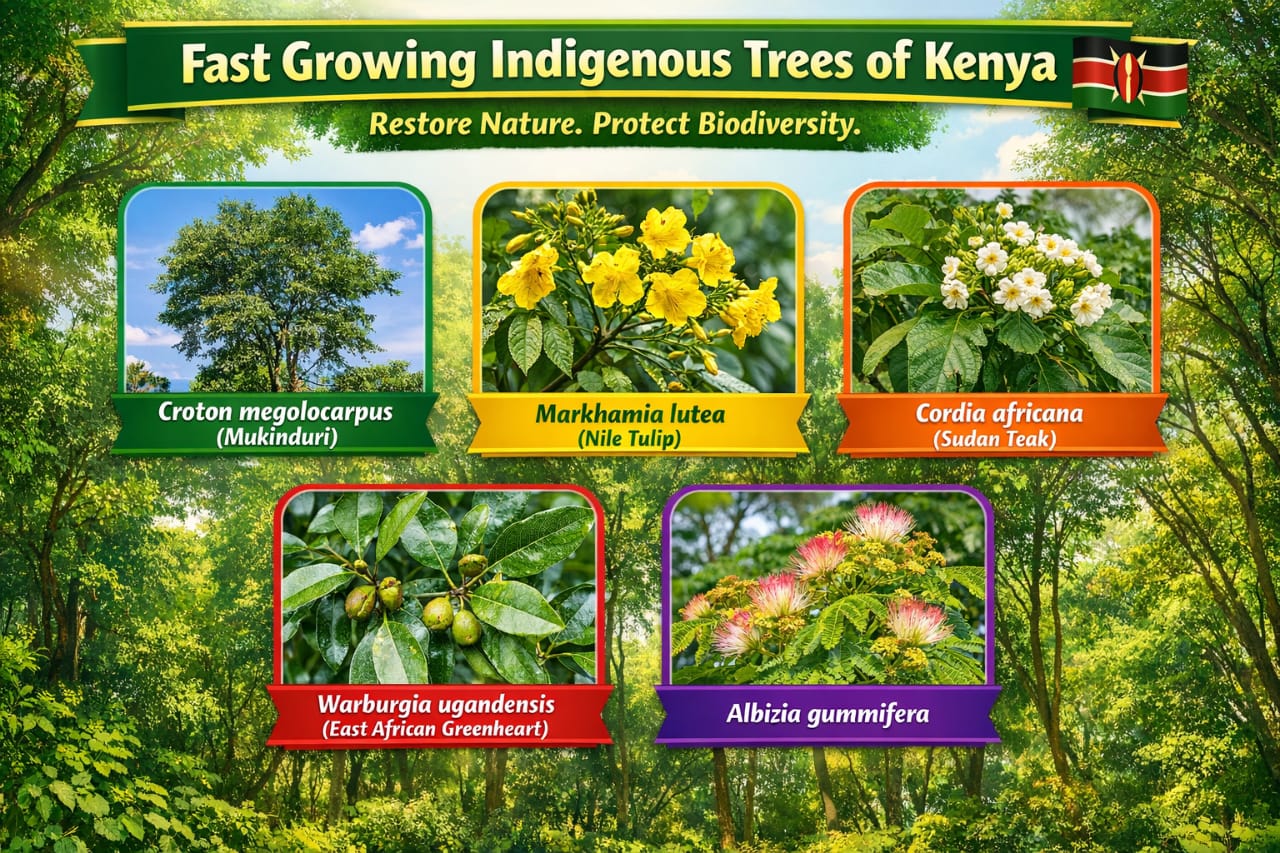
🌼 3. MARKHAMIA LUTEA
Nile Tulip
Markhamia lutea is an attractive indigenous African tree
valued for its yellow trumpet-shaped flowers, shade, and
suitability for landscaping and ecological projects.
- Indigenous species.
- Attractive yellow trumpet flowers.
- Useful shade tree.
- Suitable for schools, compounds, and institutions.
- Supports pollinators and biodiversity.
- Excellent landscaping potential.
🌿 4. CROTON MEGALOCARPUS
Mukinduri
Croton megalocarpus is an important indigenous Kenyan tree
associated with agroforestry, biodiversity, and ecosystem
restoration.
- Indigenous Kenyan species.
- Useful for reforestation.
- Supports biodiversity.
- Produces oil-rich seeds.
- Valuable hardwood.
- Suitable for restoration and agroforestry projects.
🌴 5. CASUARINA
Whistling Pine
Casuarina is well suited to coastal and windy environments
and can contribute to erosion control, windbreaks, and
landscape restoration when planted appropriately.
- Strong wind tolerance.
- Useful as a windbreak.
- Helps reduce soil erosion.
- Suitable for selected coastal environments.
- Supports landscape restoration.
- Useful in erosion-control projects.
🎋 6. BAMBOO
Bamboo is a rapidly renewable plant resource with
applications in restoration, construction, furniture,
crafts, landscaping, and community enterprise.
- Very rapid growth compared with many woody plants.
- Rapidly regenerates after appropriate harvesting.
- Useful for erosion-control projects.
- Can support soil and watershed restoration.
- Provides renewable construction material.
- Useful for furniture, fencing, crafts, and other products.
- Can create income opportunities.
- Useful for schools, farms, institutions, and community projects.
- Can provide windbreaks and landscape screening.
- Supports selected biodiversity habitats.
- Can contribute to climate and environmental initiatives.
🌍 WHY FAST-GROWING TREES MATTER
Carefully selected fast-growing trees can accelerate restoration,
provide useful resources, improve landscapes, and support
community livelihoods.
- Restore degraded landscapes.
- Support carbon sequestration.
- Provide shade for suitable locations.
- Create timber and livelihood opportunities.
- Protect soil and selected water systems.
- Strengthen ecological resilience.
🌱 Plant wisely. Nurture patiently. Multiply the impact.
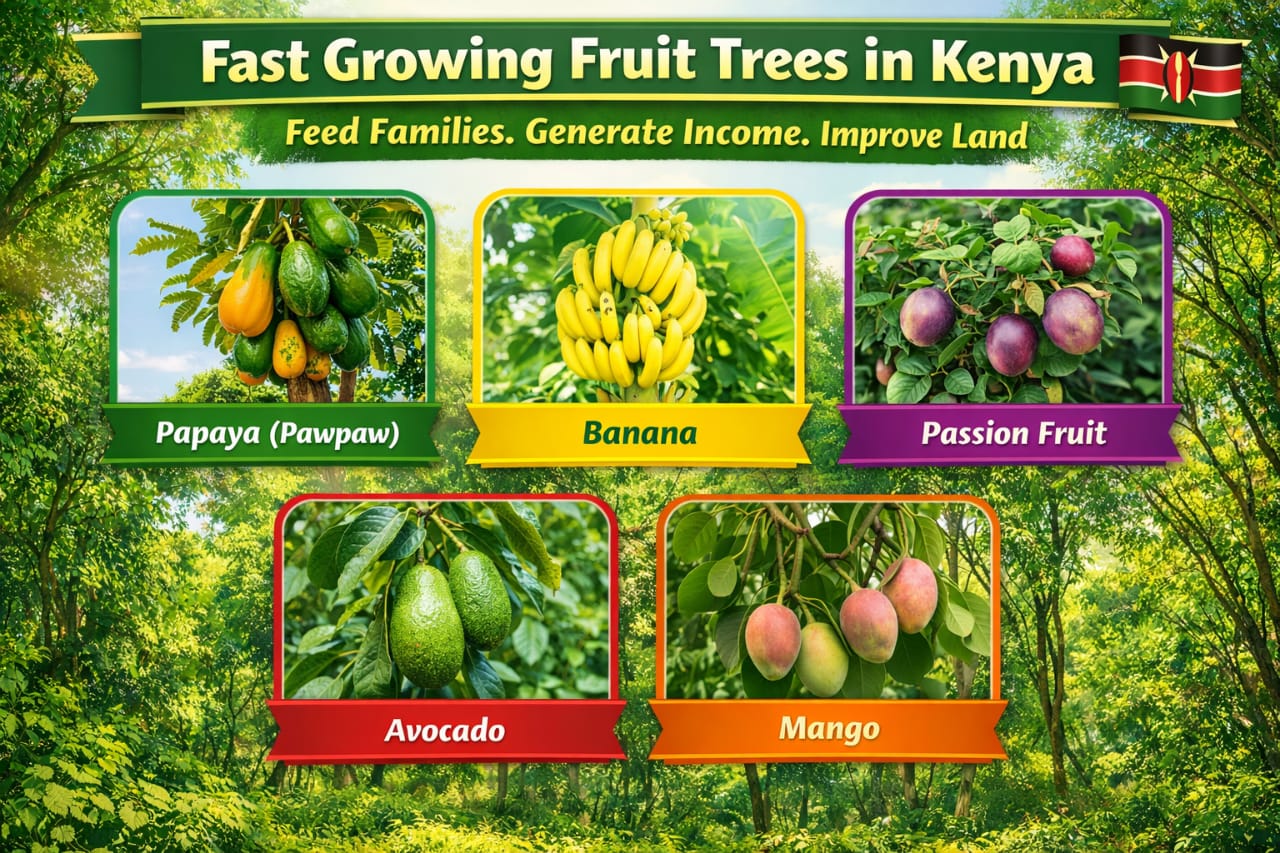
FAST-GROWING FRUIT TREES
Fruit trees can combine environmental restoration with food
production, nutrition, household income, shade, and biodiversity.
Species and varieties should be selected according to local
climate, soil, water availability, and farming conditions.
🍈 1. PAPAYA
Pawpaw
A fast-producing fruit crop suited to warm conditions and
useful for school gardens, household nutrition, and
small-scale income generation.
- Can begin producing fruit relatively quickly.
- Rich in vitamins and antioxidants.
- Useful for school nutrition programmes.
- Suitable for warm-growing environments.
- Can provide household and farm income.
🍌 2. BANANA
Bananas are an important food and income crop in many
parts of Kenya and can contribute to household food
security when grown under suitable conditions.
- Provides an important food source.
- Can produce relatively quickly.
- Useful for household income.
- Suitable for many Kenyan growing regions.
- Can support diversified farming systems.
🍊 3. PASSION FRUIT
Passion fruit is a productive climbing crop with strong
market potential and can be suitable for small-scale
agribusiness projects.
- Strong local market demand.
- Suitable for small farms.
- Can produce fruit within a relatively short period.
- Useful for juice and fresh-fruit markets.
- Suitable for agribusiness initiatives.
🥑 4. AVOCADO
Avocado is an important commercial fruit crop with strong
local and international market potential.
- High nutritional value.
- Strong local and export market potential.
- Can provide long-term farm income.
- Improved varieties can fruit earlier.
- Suitable for diversified farming systems.
🥭 5. MANGO
Mango is a valuable fruit tree for food production,
household income, and agroforestry systems, particularly
in suitable warm and semi-arid regions.
- Important food and income crop.
- Improved grafted varieties can fruit earlier.
- Strong demand in local markets.
- Suitable for several warm regions of Kenya.
- Can support long-term agroforestry systems.
🥭🌍🥑 WHY FRUIT TREES MATTER
- Improve household and community nutrition.
- Support food security.
- Create income opportunities for farmers.
- Increase plant diversity.
- Support biodiversity and ecological resilience.
- Help restore suitable degraded landscapes.
🌱 Plant fruit trees. Feed communities. Restore nature.